Blog
Corrective Action Tracking in EHS: How to Close the Loop

Quick answer: Corrective action tracking is the record that follows a deficiency from the moment an inspector finds it to the moment someone fixes it and the fix is documented. A closed-loop system creates that record automatically at the finding, gives it an owner and a due date, tracks and updates stakeholders regarding approaching deadlines, and keeps the closure on file. Most EHS programs are good at finding problems and weak at proving they were fixed, and the gap between those two is where regulatory exposure lives.
This post is for EHS coordinators and managers who already run inspections and want the follow-up to hold up as well as the inspection does. It covers what a closed loop looks like, the deadlines that apply in LDAR, stormwater, SPCC, waste, and safety programs, and why a spreadsheet keeps losing items.
Regulatory details checked against the eCFR and the 2021 EPA Multi-Sector General Permit in November 2026. This is general information, not legal advice.
Table of Contents
- Why corrective actions are where EHS programs break down
- What closed-loop hazard tracking means
- LDAR: the most deadline-driven corrective actions
- Stormwater: the permit sets the clock
- SPCC: no fixed deadline, same scrutiny
- Safety: priority decides what gets fixed first
- What good corrective action tracking looks like
- The spreadsheet problem
- FAQ
Why corrective actions are where EHS programs break down
Corrective actions break down because inspections run on a schedule and follow-up usually doesn’t. The monthly SPCC walk-through gets done. The quarterly stormwater inspection gets done. What happens after a deficiency is found is far less consistent. In many regulatory programs, the regulations fail to define a specific repair deadline.
Picture a deficiency from a monthly safety inspection. It gets written on the form, mentioned to a maintenance lead, and then one of two things happens. Either it gets fixed quickly and nobody records the closure, or it gets pushed down the list and shows up again next month, still open. Either way, there’s no record that says found on this date, assigned to this person, fixed on that date. Communication regarding the repair often occurs through email between the EH&S team and the maintenance/operations team. When the next hurdle arises, the repair is forgotten.
That gap matters during a regulatory inspection. An OSHA compliance officer or EPA inspector can look at twelve months of clean inspection records and still find fault if the deficiencies in them don’t have documented closures. “The inspection was done” and “the program is compliant” are different statements. In many cases, even if the repair is documented, the record is often kept in an arduous maintenance system such as SAP, JD Edwards, Maximo, or other systems that EH&S professionals do not operate in on a day-to-day basis. This means at audit time, they will be depending on maintenance personnel to find and pull the associated repair records. This is not a good look in an audit when the audited department can’t prove the loop was closed without help from another department.
The quieter problem is aging. Paper and spreadsheet programs have no way to surface a deficiency that’s been open for six months unless someone goes looking. In LDAR, where deadlines run in days, that’s a violation in the making.
What closed-loop hazard tracking means
A closed-loop hazard tracking system links every hazard or deficiency to a corrective action, and every corrective action to a documented closure, without relying on someone to carry the information between steps. The loop closes when the record shows the hazard was found, assigned, fixed, and confirmed. An open loop is any point where the trail depends on memory, email, or a sticky note.
In practice, a closed loop has four links:
- Detection creates the record. The corrective action exists the moment the inspector records the deficiency, not after someone gets back to a desk.
- The record has an owner and a due date. A named person, not a department.
- The system tracks the deadline. Reminders arrive before the due date, not after.
- Closure is documented. Who fixed it, when, what they did, and any follow-up check.
Break any one of those and you have an open loop, even if the physical repair happened.
LDAR: the most deadline-driven corrective actions
Leak detection and repair (LDAR) has the tightest corrective action deadlines in routine EHS work: a first repair attempt within 5 calendar days of finding a leak, and a completed repair within 15 calendar days. Those clocks run in calendar days, not business days, and they start at detection.
At refineries, the structure comes from NESHAP Subpart CC, which sends existing sources to the Part 60 Subpart VV equipment leak rules and new sources to Part 63 Subpart H. Under Subpart VV, a leak found by Method 21 monitoring needs a first attempt at repair within 5 days and a repair within 15 days.
Delay of Repair (DOR). When a repair within 15 days isn’t technically feasible without a process unit shutdown, the rules allow a delay, with the repair completed by the end of the next shutdown. A DOR is a documented exception, not a waiver. It needs a responsible person, a reason, and an anticipated repair date.
Follow-Up Monitoring (FUM). A repair isn’t closed until monitoring confirms it held. That follow-up has its own deadline, and a component marked “repaired” with no follow-up reading doesn’t have a clean closure.
Running that lifecycle across thousands of tagged components isn’t something a spreadsheet does well. Our LDAR compliance software builds the 5-day and 15-day deadlines, DOR, and FUM into the Repair record, with FUM deadlines calculated automatically or set by hand. Those LDAR clocks apply to Method 21 and OVA inspections. Optical gas imaging surveys follow their own rule’s repair schedule.
Stormwater: the permit sets the clock
Industrial stormwater corrective actions have deadlines written into the permit itself. Under EPA’s Multi-Sector General Permit, you have to take reasonable steps the same day you find a problem, finish the corrective action within 14 calendar days, and go no later than 45 days without notifying EPA. Some states have even more stringent deadlines than the EPA MSGP.
The permit lists what triggers a corrective action: a spill or unauthorized discharge, a control measure that was never installed or isn’t maintained, controls that aren’t stringent enough, an exceeded effluent limit, or a quarterly visual assessment that shows pollution. Documentation runs on its own clock. You record the condition and your immediate response within 24 hours, and the full corrective action within 14 days or other set deadline.
State permits vary, but most follow the same pattern. The practical point is the same everywhere: the stormwater corrective action starts the day the inspector sees the problem. Our stormwater inspection software creates the Repair at that moment and notifies all stakeholders as the deadline approaches if the repair has not been implemented.
SPCC: no fixed deadline, same scrutiny
SPCC corrective actions don’t come with a regulatory day count the way LDAR repairs do. They still get scrutinized. When a monthly inspection finds a cracked containment berm, a level gauge that isn’t reading, or rainwater eating into secondary containment capacity, the expectation is that the problem gets fixed and the fix gets recorded.
What trips up SPCC programs usually isn’t a missed deadline. It’s a fix with no record. An inspector notes damaged containment on the September form and tells the maintenance crew. By December it’s repaired, but nothing shows when, by whom, or whether anyone checked.
Now the EPA inspector asks about September. The facility can’t point to a repair record. The real question becomes whether containment was inadequate for three months. A corrective action record with a found date, a fix date, and a name answers that question in one line. Our SPCC inspection software keeps that record attached to the inspection that found the problem. Not only does it track corrective action records, facilities have the ability to create their internal deadline system based on the severity of the finding. For instance, some facilities set their low priority findings with a 60-day repair deadline, their medium priority findings with a 30-day deadline and their high priority findings with a 24-hour deadline.
Safety: priority decides what gets fixed first
Safety corrective actions rarely have a regulatory day count, but they carry the highest consequence when they’re mishandled. A machine guarding deficiency that sits open for six months while the facility waits for a part, with no temporary control and no tracked timeline, is exactly the kind of gap that turns up in an OSHA citation after an injury.
That’s why priority matters. A cracked floor in a low-traffic corridor and a damaged guard on running equipment aren’t the same risk, and a first-in, first-out list treats them as if they were. Good safety tracking assigns priority when the item is created, tracks it through repair, and makes overdue high-priority items visible to managers before they become injuries or citations. This is another instance where EHSTracks® finding priority ratings become useful. In EHSTracks®, products can use High, Medium, and Low priority, and the priority feeds into the due date. A new high-priority corrective action also triggers an email notification. See our safety inspection software for how that runs in the field.
What good corrective action tracking looks like
Good corrective action tracking creates the record automatically when a deficiency is found, assigns it to a named person with a due date, sends reminders before that date, and keeps the closure on file. Whatever the program, those are the pieces auditors look for.
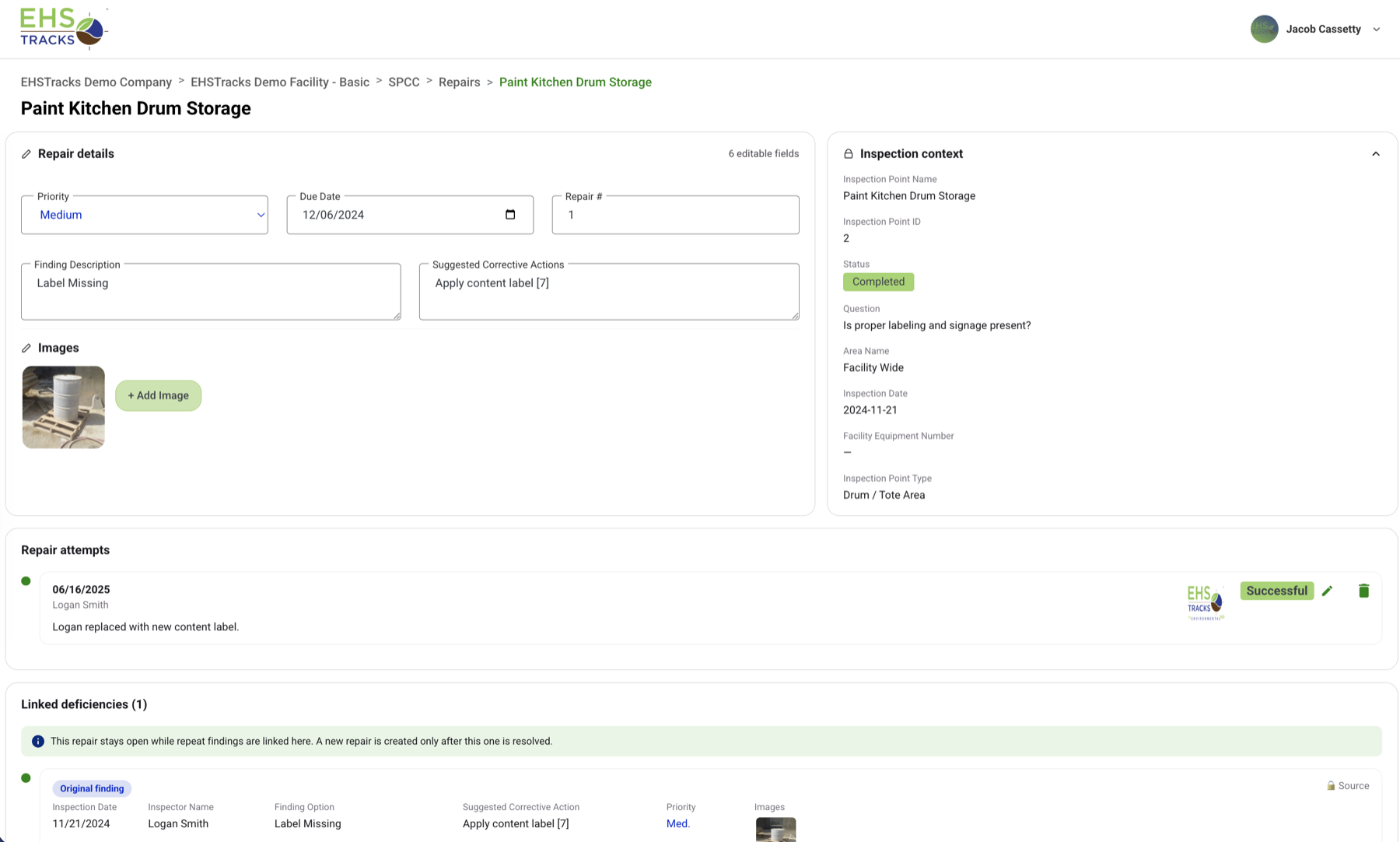
Automatic creation at the finding. If someone has to open a separate system to log a corrective action, it’ll be missed or delayed. In EHSTracks®, answering “No” on any inspection question creates a Repair record automatically, right there in the mobile app, even offline.
Ownership and history. Each repair attempt records the date, the responsible person, a description, a status, and photos, through to completion. LDAR Repairs add DOR with its reason and anticipated date, plus FUM.
Deadlines that come to you. Coordinators shouldn’t have to query for overdue items. EHSTracks® sends email notifications when a corrective action is due in 15, 7, 3, and 1 days, when it’s past due, and when a new high-priority item is created. The facility dashboard shows outstanding, due-soon, and past-due counts, with an LDAR stage breakdown.
Follow-up that doesn’t depend on who’s on shift. Every inspection point sits on the facility’s satellite map, so whoever is covering can find the points that have open Repairs without waiting for the person who logged them.
When the loop works, an inspector’s “No” in the field and the maintenance lead’s “done” on Friday end up in the same record. More detail is on our Repairs features page.
The spreadsheet problem
Most manual corrective action tracking lives in Excel. Spreadsheets are flexible, familiar, and free, and they’re structurally wrong for this job.
A spreadsheet doesn’t warn you when an LDAR repair is about to pass day 5. It doesn’t stop someone from marking a row closed without a repair date. It doesn’t sort open items by program and priority on its own. It doesn’t enforce ownership at all: rows get deleted, items get marked closed without proof, tabs get forgotten.
The facilities most exposed here aren’t the ones ignoring deficiencies. They’re the ones where a capable coordinator is managing a dozen programs on a tool that puts every follow-up on their shoulders. Take that person away for two weeks and the loop opens.
Waste programs work the same way. A damaged container or missing label in a hazardous waste storage area needs a tracked fix like anything else, and our hazardous waste compliance software keeps it in the same workflow. For the bigger picture on accumulation dates and manifests, see our guide to hazardous waste tracking software.
FAQ
What is corrective action tracking in EHS?
Corrective action tracking is the documented trail from a deficiency found during an inspection to its verified fix: when it was found, who owns it, the due date, the repair attempts, and the closure. It’s how an EHS program proves problems were fixed, not just found.
What is a closed-loop hazard tracking system?
A closed-loop hazard tracking system automatically links each hazard or deficiency to a corrective action, assigns an owner and a due date, sends reminders before the deadline, and keeps the closure record. The loop is closed when nothing between finding and fixing depends on memory or an informal handoff.
What are the LDAR repair deadlines?
Under the equipment leak rules that apply at many refineries and chemical plants, such as 40 CFR Part 60 Subpart VV, a first repair attempt is due within 5 calendar days of detecting a leak and the repair within 15 calendar days. Oil and gas sites under Subpart OOOOa follow different, 30-day timelines.
What is a Delay of Repair?
A Delay of Repair (DOR) is a documented exception for a leak that can’t be repaired within 15 days without a process unit shutdown. The repair must be finished by the end of the next shutdown. A valid DOR record names the responsible person, the reason for the delay, and the anticipated repair date.
Can a failed inspection item create a corrective action automatically?
Yes. In EHSTracks®, answering “No” on an inspection question automatically creates a Repair record in the mobile app, even offline. The Repair then tracks attempts, the responsible person, and completion, and email notifications go out as its due date approaches or passes.
Want to see a “No” in the field turn into a tracked Repair? Talk to the EHSTracks® team.