
Blog
EPA Refrigerant Leak Repair Rules: 2026 Guide
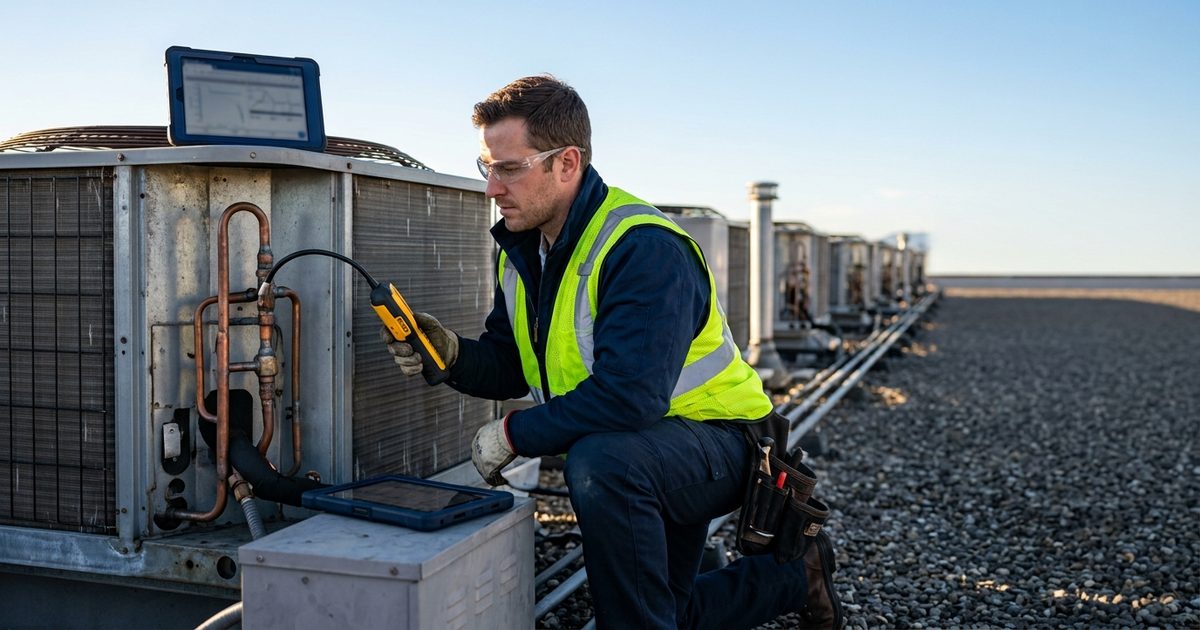
EPA’s refrigerant leak repair rule, in short: Since January 1, 2026, owners and operators of appliances holding 15 or more pounds of HFC refrigerant (or a substitute with a GWP above 53) must calculate a leak rate whenever refrigerant is added, repair leaks above 10%, 20%, or 30% within 30 days, verify every repair twice, and keep records.
Regulatory details current as of October 7, 2026. Check the eCFR for updates. This article is general information, not legal advice.
Finding the leak is the easy part. The hard part is everything after it: which units were inspected, what was found, who attempted the repair, whether it held, and when the unit is due again. At most facilities that history lives in contractor tickets, a maintenance spreadsheet, and email. It works until an auditor asks for the follow-up verification test on a rooftop unit from last spring.
If you’re an EHS director, a facility manager, or the maintenance lead who actually carries this work, this guide is for you. It covers what the rule requires, which records you need, and how to run the program without a spreadsheet holding it together.
Table of Contents
- Who Has to Comply With EPA’s Refrigerant Leak Repair Rule?
- What Are the Leak Repair, Verification, and Inspection Requirements?
- What Leak Inspection Methods Does EPA Accept?
- What Records Do Facilities Need to Keep?
- How Do Facilities Run a Refrigerant Leak Program Day to Day?
- What This Means for EHS and Facility Leaders
- FAQ
Who Has to Comply With EPA’s Refrigerant Leak Repair Rule?
The requirements come from the American Innovation and Manufacturing (AIM) Act, which directs EPA to phase down hydrofluorocarbons (HFCs). EPA’s Emissions Reduction and Reclamation (ER&R) rule, published October 11, 2024, put those requirements into 40 CFR Part 84, Subpart C. The leak repair section is §84.106.
Under §84.106(a), the rule applies to refrigerant-containing appliances with a full charge of 15 pounds or more where the refrigerant contains either:
- an HFC (a “regulated substance” under the AIM Act), or
- a substitute with a global warming potential (GWP) greater than 53.
Two categories are excluded outright: appliances in the residential and light commercial air conditioning and heat pump subsector, and appliances containing solely an ozone-depleting refrigerant (those stay under Section 608, covered below). EPA’s leak repair fact sheet notes that chillers and certain variable refrigerant flow systems sit in their own subsectors, so they aren’t swept into that residential and light commercial exclusion.
One detail changes how you count equipment. EPA defines each independent refrigerant circuit as a separate appliance (§84.102). A rack system or chiller with three independent circuits is three appliances for leak rate purposes, each with its own full charge.
EPA has also proposed (May 2026) to exempt road and intermodal container transport refrigeration units from §84.106. As of this writing, that exemption has not been finalized in the eCFR.
States may be stricter (California’s Refrigerant Management Program, for example), so check state rules too.
What Are the Leak Repair, Verification, and Inspection Requirements?
The whole rule hangs on one number: the leak rate. Owners or operators must calculate it every time refrigerant is added to a covered appliance, with narrow exceptions for retrofits, new installations, and seasonal variances (§84.106(b)). If the result exceeds the threshold for that appliance type, a chain of deadlines starts.
| Requirement | Applies to | Threshold or deadline | Source |
|---|---|---|---|
| Determine and record full charge | Every covered appliance | By Jan 1, 2026, or at installation for newer units | §84.106(l)(1) |
| Leak rate calculation | Every refrigerant addition (limited exceptions) | Each time refrigerant is added | §84.106(b) |
| Repair trigger | Commercial refrigeration | Leak rate over 20% | §84.106(c)(2) |
| Repair trigger | Industrial process refrigeration | Leak rate over 30% | §84.106(c)(2) |
| Repair trigger | Comfort cooling, refrigerated transport, other 15+ lb appliances | Leak rate over 10% | §84.106(c)(2) |
| Leak inspection and repair by a certified technician | Appliances over their leak rate | Within 30 days of the refrigerant addition (120 days if an industrial process shutdown is required) | §84.106(d) |
| Initial verification test | Each repaired leak | Within the same 30-day (or 120-day) window | §84.106(e)(1) |
| Follow-up verification test | Each repaired leak | Within 10 days of a successful initial test, or 10 days after return to normal operating conditions if the unit was evacuated | §84.106(e)(2) |
| Recurring leak inspections | Commercial or industrial process refrigeration, 500+ lb | Every 3 months after the follow-up test, until 4 consecutive quarters below the leak rate | §84.106(g) |
| Recurring leak inspections | Commercial or industrial process refrigeration 15 to 499 lb; comfort cooling and other appliances | Once a year after the follow-up test, until one year below the leak rate | §84.106(g) |
| Retrofit or retirement plan | Appliances still leaking after repairs, or where the owner chooses not to repair | Plan within 30 days; work finished within one year | §84.106(h) |
| Chronic leaker report | Appliances that leak 125% or more of full charge in a calendar year | Report to EPA by March 1 of the next year | §84.106(j) |
| Automatic leak detection (ALD) | Commercial and industrial process refrigeration, 1,500+ lb | At or within 30 days of installation for units installed on or after Jan 1, 2026; by Jan 1, 2027 for units installed 2017 through 2025 | §84.108 |
Three details in that table trip people up.
The repair clock starts at the top-off. Not when someone gets around to the math. A Friday top-off that puts a comfort cooling unit at 14% started the clock on Friday.
Extensions exist, but they’re narrow. If replacement parts aren’t available within 30 days, §84.106(f) allows more time, capped at 180 days (270 with an industrial process shutdown). You still have to document every repair effort, and the request goes through EPA’s reporting platform inside the original window, not after it runs out.
The third is a planning question more than a trap. If you run large commercial or industrial systems, the January 1, 2027 ALD deadline is less than three months away. Appliances (or portions of them) continuously monitored by an ALD system that’s audited or calibrated annually don’t need the quarterly or annual inspections at all (§84.106(g)(4)). So the ALD decision and the inspection schedule are really one decision.
What Leak Inspection Methods Does EPA Accept?
EPA doesn’t mandate one method. The certified technician picks what fits the appliance (§84.106(g)(2)). The §84.102 definition of “leak inspection” lists potential methods including:
- ultrasonic tests
- gas-imaging cameras
- bubble tests, as appropriate
- leak detection devices operated and maintained per the manufacturer’s guidelines
The catch: methods that tell you a unit is leaking but not where (standing pressure or vacuum decay tests, sight glass checks, receiver levels, pressure checks, charging charts) must be paired with a method that locates the leak.
For follow-up verification tests, EPA’s list adds pressure or vacuum tests, fluorescent dye and black light, and infrared or near-infrared tests.
Inspections cover all visible and accessible components. The rule carves out components that are insulated, under ice, underground, or behind walls; anything requiring a person to be elevated more than two meters above a support surface; and components site personnel judge unsafe to inspect (§84.106(g)(3)).
The field test establishes the result. Your job is making sure the record of it exists and can be found.
What Records Do Facilities Need to Keep?
Under §84.106(l), records must be kept for at least three years, in paper or electronic form, unless the rule says otherwise. The core set:
- Appliance records: owner or operator, address, full charge and how it was determined, any revisions, and installation date. Keep these until three years after the appliance is retired.
- Service records for every installation, service, repair, or disposal: appliance identity and location, date, parts worked on, type of work, who did it, the amount and type of refrigerant added or removed, full charge, and the leak rate with its calculation method.
- Leak inspection records: date, method(s) used, the location of each leak found, and a certification that all visible and accessible parts were inspected.
- Verification test records: appliance location, test dates, locations of the repaired leaks tested, test types, and results.
- ALD records, where applicable: installation, annual audit and calibration, each alert date, and the leak location behind each alert (§84.108(i)).
- Retrofit or retirement plans, extension requests, mothballing dates, and copies of anything submitted to EPA.
When a contractor does the work, §84.106(l)(4) requires them to hand you the service record. The obligation still sits with the owner or operator. If that paperwork lives in the contractor’s system and not yours, you have a gap.
How Part 84 relates to Section 608
Section 608 of the Clean Air Act, implemented at 40 CFR Part 82, Subpart F, still governs ozone-depleting refrigerants like R-22. Its leak repair provisions (§82.157) apply to appliances with 50 or more pounds of class I or class II refrigerant. Part 84 covers HFCs and higher-GWP substitutes at 15 pounds. Technicians doing Part 84 work must hold Section 608 certification under §82.161. A facility with a mix of older R-22 equipment and newer HFC units is running under both rules, with different thresholds for each.
How Do Facilities Run a Refrigerant Leak Program Day to Day?
Refrigerant leak management runs on the same discipline LDAR programs already run on: know every component, inspect on schedule, repair inside the deadline, prove the repair held, and keep monitoring. EHSTracks doesn’t have a dedicated refrigerant product. Facilities can build the program with FLEX custom inspection programs, configured around their own equipment and procedures.
Here’s how that workflow lays out.
1. Put every covered appliance on the map
Start with an inventory: every appliance at 15 pounds or more, each independent circuit counted separately. In FLEX, each one goes on a satellite map of the facility as an inspection point (the map is a patented feature of the EHSTracks platform), and you type in that point’s question list as you add it.
For an inspector, that means finding the right unit on a roof with 40 identical RTUs. For EHS, it’s one place to see what’s been checked.
2. Inspect and document, whatever method the technician uses
Since you write the questions for each point, you can build them around exactly what §84.106(l)(5) asks for. Was a leak found? Which method was used? Were all visible and accessible components inspected? Photos document the leak location. A 600-pound supermarket rack on quarterly inspections can carry different questions than a 20-pound walk-in cooler. You just write them that way when you add each one.
GPS distance-deviation enforcement (also patented) requires an inspector recording away from the asset to justify it. The app works fully offline on iOS, Android, or a browser and syncs later, which matters in mechanical rooms with no signal.
3. Track every repair attempt against the asset
Repairs don’t always hold on the first try. A failed inspection item automatically creates a Repair (corrective action) in EHSTracks with an owner and a due date, and email reminders keep maintenance aware of what’s still open. Each attempt stays attached to the appliance, so the next technician sees what’s already been tried.
4. Keep verification separate from repair completion
This is the point most programs miss. A closed maintenance work order does not demonstrate a successful repair. The rule requires an initial verification test and a follow-up verification test for each repaired leak, and each needs its own record: date, location, test type, result. Treat them as distinct inspection steps, not as a checkbox on the repair ticket.
5. Keep recurring inspections on the schedule
Once an appliance exceeds its leak rate, it’s on quarterly or annual inspections until it proves it’s stable. That’s the step people forget. FLEX includes automated recurring scheduling, so the cadence for each appliance can be set once instead of remembered. The facility dashboard shows what’s done, pending, missed, and open across every site, and reports export for audits.
None of that calculates your leak rate or makes you compliant on its own. It keeps the evidence together and makes the next required step hard to lose.
What This Means for EHS and Facility Leaders
Violations under a rule like this rarely come from not knowing it exists. They come from the follow-up test nobody scheduled. The annual inspection that slipped when a tech left. The contractor record that never reached the file.
That’s where the budget case lives. When an auditor asks about one appliance, someone on your team either pulls its inspections, repairs, and verification tests from one place, or spends an afternoon digging through tickets, spreadsheets, and inboxes. Now multiply that by every covered unit at every site.
Verification tests and recurring inspections are exactly where programs fall behind, and scheduled work with email reminders is harder to forget than a note on a whiteboard. You also get one view of every appliance and every open repair across your facilities, including what each inspector or contractor has and hasn’t done. When someone new joins, they follow the configured checklist. Nobody has to memorize §84.106.
Your field people get the simpler version: find the unit on the map, answer a short checklist, take photos, move on (signal or not). They don’t track when the unit’s due next. The schedule does.
If you’re still sorting out what EHS compliance software does, refrigerant is a good test case. It’s repetitive, deadline-driven, and split three ways between EHS, maintenance, and contractors.
FAQ
When did the EPA refrigerant leak repair requirements take effect?
EPA’s leak repair requirements at 40 CFR 84.106 apply as of January 1, 2026. By that date, owners and operators also had to determine and record the full charge of every covered appliance with 15 or more pounds of refrigerant. Automatic leak detection requirements for large commercial and industrial process refrigeration systems installed between 2017 and 2025 take effect January 1, 2027.
Does the leak repair rule apply to equipment using HFOs or other low-GWP refrigerants?
It depends on what the refrigerant contains. Under 40 CFR 84.106(a), the rule covers appliances whose refrigerant contains an HFC, or a substitute with a global warming potential greater than 53. A substitute at a GWP of 53 or below is not covered. Because many HFO blends include an HFC component, check the refrigerant’s actual composition before assuming an appliance is exempt.
What leak rate triggers a required repair?
Under 40 CFR 84.106(c)(2), the repair threshold depends on the appliance type. Commercial refrigeration appliances must be repaired when the leak rate exceeds 20 percent. Industrial process refrigeration appliances trigger at 30 percent. Comfort cooling, refrigerated transport, and other appliances with 15 or more pounds of refrigerant trigger at 10 percent. The leak rate must be calculated every time refrigerant is added, with limited exceptions.
How soon after a repair is a verification test required?
Each repaired leak needs two tests. The initial verification test must be completed within 30 days of the appliance exceeding its leak rate, or 120 days if an industrial process shutdown is required. The follow-up verification test must be done within 10 days of a successful initial test, or within 10 days of the appliance returning to normal operating conditions if it was evacuated for repair.
How long do refrigerant leak inspection and repair records need to be kept?
Under 40 CFR 84.106(l), records must be kept for at least three years in paper or electronic form. That includes service records, leak inspection records, verification test results, and automatic leak detection records. Appliance records, including the full charge and how it was determined, must be kept until three years after the appliance is retired.
What is the difference between 40 CFR Part 84 and Section 608?
Section 608 rules at 40 CFR Part 82, Subpart F govern ozone-depleting refrigerants such as R-22, with leak repair required for appliances holding 50 or more pounds. 40 CFR Part 84, Subpart C covers HFCs and substitutes with a GWP above 53, starting at 15 pounds. Appliances containing only an ozone-depleting refrigerant are excluded from Part 84. Technicians working under either rule need Section 608 certification.
Can a facility track refrigerant inspections and repairs in the same system as its other EHS inspections?
Yes. A configurable inspection platform can manage refrigerant appliances alongside stormwater, SPCC, waste, and safety inspections. In EHSTracks, FLEX custom inspection programs handle the asset map, inspection checklists, photos, and recurring schedules, and failed items create repairs with owners and due dates. The system organizes the records. It does not calculate leak rates or replace a certified technician’s judgment.
Talk Through Your Refrigerant Program
If refrigerant inspections and repair follow-up are turning into a headache at your facility, we’re happy to look at how FLEX custom inspection programs could map your appliances, document the work, and keep the next required step on track. Get in touch with our team and we’ll walk through it with your equipment list in front of us.